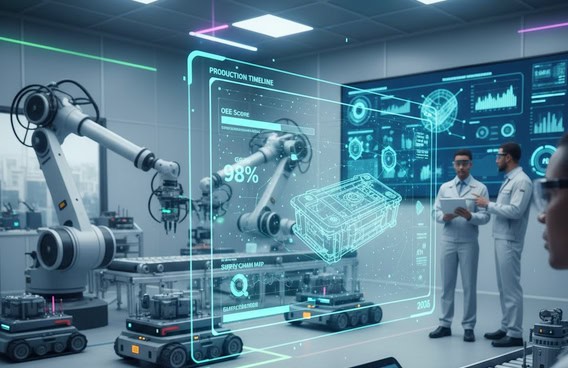
In the competitive industrial landscape of 2026, manufacturing software has evolved from a simple record-keeping tool into a sophisticated “Digital Nervous System.” Modern solutions leverage Artificial Intelligence (AI), the Industrial Internet of Things (IIoT), and digital twin technology to create resilient, self-optimizing production environments.
This guide explores the 15 premier manufacturing software solutions for 2026, categorized by their core operational strengths.
15 Best Manufacturing Software Solutions in 2026
Top-Tier Enterprise Resource Planning (ERP)
-
SAP S/4HANA: The industry benchmark for global enterprises. In 2026, its AI-driven “predictive path” helps large-scale manufacturers simulate supply chain disruptions before they occur.
-
Oracle NetSuite: A leader in cloud-native manufacturing. It provides a unified data model that seamlessly connects shop-floor work orders with executive-level financial reporting.
-
Microsoft Dynamics 365 Supply Chain: Renowned for its deep integration with the Power Platform, allowing manufacturers to build custom low-code apps for specific floor tasks.
-
Epicor Kinetic: Purpose-built for discrete manufacturing, Kinetic excels in complex production environments like aerospace and medical devices with robust version control.
-
Acumatica Manufacturing Edition: An agile, cloud-native option favored by mid-market manufacturers for its flexible consumption-based pricing model.
Specialized Manufacturing Execution Systems (MES)
-
Plex Smart Manufacturing Platform: A “shop-floor first” solution. It offers real-time machine integration and unparalleled traceability for high-compliance industries like automotive.
-
Tulip: A no-code frontline operations platform. Tulip allows engineers to build “apps” for operators, turning manual assembly lines into data-capturing digital workflows.
-
Siemens Opcenter: Part of the Xcelerator portfolio, it bridges the gap between PLM and the physical shop floor, specializing in high-tech electronics and semiconductors.
-
MasterControl Manufacturing Excellence: The premier choice for life sciences, focusing on paperless production and maintaining the “Golden Batch” for pharmaceutical compliance.
Agile MRP & Inventory Solutions
-
MRPeasy: Designed specifically for small-to-midsize manufacturers. It is highly regarded for its ease of implementation—often going live in weeks rather than months.
-
Katana Cloud Inventory: A favorite for direct-to-consumer (DTC) brands, Katana offers visual production scheduling and native integrations with Shopify and BigCommerce.
-
Fishbowl: The most robust choice for businesses already using QuickBooks, extending simple accounting into a powerful inventory and manufacturing engine.
Product Lifecycle Management (PLM) & Innovation
-
Siemens Teamcenter: The world’s most widely used PLM system. It manages the “Digital Twin” of a product from initial 3D design to end-of-life recycling.
-
Autodesk Fusion 360 (Manage): A cloud-based PLM that connects CAD, CAM, and CAE, making it ideal for distributed engineering teams.
-
Aras Innovator: Known for its highly flexible, open-architecture approach, allowing companies to customize their PLM workflows without the risk of vendor lock-in.
Strategic Categories of Manufacturing Software
1. Enterprise Resource Planning (ERP)
ERP systems serve as the centralized “brain” of a manufacturing business. They integrate disparate functions—Finance, HR, and Sales—with production data to provide a single source of truth. In 2026, modern ERPs are increasingly “composable,” allowing manufacturers to plug in specific modules as they scale.
2. Manufacturing Execution Systems (MES)
While the ERP focuses on the office, the MES focuses on the floor. These systems provide real-time monitoring of machine performance (OEE), labor tracking, and quality control. They are essential for achieving a “Smart Factory” status.
3. Material Requirements Planning (MRP)
MRP software is the engine behind inventory optimization. By analyzing the Bill of Materials (BOM) against current stock and lead times, it calculates exactly what to buy and when to build, preventing both stockouts and capital-heavy overstocking.
4. Product Lifecycle Management (PLM)
PLM software manages the “intellectual capital” of a product. It tracks every iteration of a design, ensuring that engineering changes are instantly reflected in the production line’s instructions.
Key Features for 2026 Optimization
-
Real-Time Data Acquisition: Integration with IoT sensors to monitor machine health and energy consumption.
-
Predictive Maintenance: AI algorithms that analyze vibration and temperature data to predict equipment failure before it causes downtime.
-
End-to-End Traceability: The ability to trace a finished product back to the specific lot of raw materials used, critical for recall management.
-
Automated Costing: Real-time tracking of labor, machine time, and material waste to provide an accurate Actual Cost vs. Standard Cost analysis.
Final Words
Modern manufacturing software in 2026 serves as a Digital Thread, seamlessly connecting product design, shop-floor execution, and global supply chain logistics into a single, AI-optimized workflow.